📑 Table of Contents
- Executive Overview: The CapEx Trap in Commercial Perimeter Fencing
- Macro Market Drivers: Escalating Labor Rates & ESG Pressures
- Material Engineering Benchmark: Co-Extruded WPC vs. ACQ Timber
- 10-Year TCO Financial Model: 1,000 Linear Foot Commercial Case Study
- The Cap Rate Multiplier: Translating OpEx Savings into Commercial Property Value
- Global Sourcing Bottlenecks & The Structa Deck Factory-Direct Advantage
- Strategic Playbook for Wholesalers, EPCs, and Commercial Developers
- Conclusion & Next Steps for Procurement Teams
1. Executive Overview: The CapEx Trap in Commercial Perimeter Fencing
For decades, commercial general contractors, multifamily developers, and institutional procurement directors treated perimeter fencing as a low-consideration commodity line item. When bidding on large-scale logistics yards, residential subdivisions, or hospitality boundaries, specification teams consistently defaulted to Alkaline Copper Quaternary (ACQ) Pressure-Treated (PT) Southern Yellow Pine or Douglas Fir purely based on lowest upfront material acquisition cost (CapEx).
However, in commercial real estate (CRE) asset management, initial acquisition cost represents less than 40% of the true 10-year lifecycle expenditure.
┌─────────────────────────────────────────────────────────────────────────────┐
│  THE 10-YEAR COMMERCIAL FENCING REALITY (1,000 Linear Foot Baseline)        │
│                                                                             │
│  ■ ACQ Pressure-Treated Wood:                                               │
│    Initial CapEx: $38,500 ──► Recurring Maintenance & Rot: +$28,650 ──────► │
│    10-Year Total: $67,150 ($67.15 / LF)                                     │
│                                                                             │
│  ■ Structa Deck Co-Extruded WPC System:                                     │
│    Initial CapEx: $43,300 ──► Routine Water Washing Only:   +$770 ────────► │
│    10-Year Total: $44,070 ($44.07 / LF)                                     │
│                                                                             │
│  ► NET 10-YEAR SAVINGS: $23,080 per 1,000 LF (-38.4% Cumulative TCO)        │
│  ► CAPEX-OPEX BREAKEVEN HORIZON: Year 3.8 (Month 46)                        │
└─────────────────────────────────────────────────────────────────────────────┘
When exterior trade wages fluctuate and commercial facilities operate under strict Net Operating Income (NOI) targets, natural softwood fencing transforms from a “budget-friendly” selection into a compounding operational liability.
This comprehensive analysis evaluates the structural, environmental, and financial mechanics of 2nd-Generation Co-Extruded (360° Shielded) WPC Fencing Systems
versus standard commercial-grade treated timber.
2. Macro Market Drivers: Escalating Labor Rates & ESG Pressures
The global commercial fencing market is projected to reach $48.2 billion by 2032, expanding at a 5.6% CAGR. Within this sector, engineered polymers and wood-plastic composites (WPC)
represent the fastest-accelerating segment (11.2% CAGR), rapidly displacing traditional lumber in commercial submittals.
+-------------------------------------------------------------------------------+
| IMAGE PLACEHOLDER:                                                            |
| File Name: commercial-wpc-fencing-vs-timber-macro-trends.webp                 |
| Alt Text: Commercial perimeter fencing market growth and composite adoption  |
| Caption: Fig 1. Shift in commercial perimeter specification from treated wood  |
|          to co-extruded composite systems across North America and Europe.    |
+-------------------------------------------------------------------------------+
2.1 Compounding Exterior Maintenance Labor Inflation
According to recent commercial construction indices:
- North American trade labor rates for exterior maintenance and fence staining have increased at a 6.2% compound annual rate since 2022.
- Western European facility management contracts reflect an average 5.8% annual wage escalation.
Softwood lumber requires chemical pressure washing, mildew stripping, and solvent-based resealing every 24 to 36 months. For a 50-acre multifamily property or industrial logistics park, these continuous labor mobilizations severely erode developer cash flows and property management margins.
2.2 Strict Environmental Regulations & ESG Compliance
- Chemical Leaching & Disposal Bans: In jurisdictions adhering to stringent environmental guidelines (such as California Title 24, Washington State storm runoff standards, and EU environmental directives), discarded copper- and arsenic-treated lumber cannot enter standard municipal landfills. Soil leaching around perimeter foundations creates long-term environmental remediation risks.
- EUDR Traceability Mandates: Under the EU Deforestation Regulation (EUDR), commercial timber importers face complex documentation audits. Conversely, high-performance WPC systems utilize 95%+ recycled raw materials (60% reclaimed industrial hardwood fiber + 35% recycled High-Density Polyethylene [HDPE]), qualifying projects for LEED v4.1 and BREEAM green building certification credits.
3. Material Engineering Benchmark: Co-Extruded WPC vs. ACQ Timber
Early 1st-generation uncapped composite fencing gained a mixed reputation due to thermal expansion issues and surface staining. Today’s commercial-grade 2nd-Generation 360° Co-Extruded WPC utilizes an ultra-dense, modified polymer outer shield co-extruded simultaneously over an engineered core.
+-------------------------------------------------------------------------------+
| IMAGE PLACEHOLDER:                                                            |
| File Name: co-extruded-wpc-fencing-cross-section-engineering.webp             |
| Alt Text: 360-degree co-extruded WPC fencing cross section and aluminum post   |
| Caption: Fig 2. Engineering cross-section of Structa Deck full-shield WPC     |
|          interlocking board with internal structural ribbing.                 |
+-------------------------------------------------------------------------------+
Below is the verified engineering comparison based on international testing protocols:
| Engineering Parameter | Test Protocol / Standard | ACQ Pressure-Treated Wood | Structa Deck Co-Extruded WPC System | B2B Commercial Project Impact |
| Moisture Absorption (24h) | ASTM D570 / EN 317 | 25.0% – 42.0% (Severe swelling) | < 0.45% (Hydrophobic barrier) | Eliminates board warping, cupping, and freeze-thaw cracking |
| Flexural Strength (MOR) | ASTM D6109 / EN 310 | 28 – 40 MPa (Degrades over time) | 34 – 42 MPa (Stable polymer matrix) | Sustained structural span integrity under mechanical impact |
| UV Resistance (3,000 hrs) | ASTM G154 / ISO 4892-2 | Severe graying, splintering | $\Delta E \le 2.5$ (HALS protected) | Zero repainting or re-staining required over lifetime |
| Fire Reaction Class | ASTM E84 / EN 13501-1 | Class C (FSI: 110–190) | Class B / Bfl-s1 (Flame retardant) | Approved for high-density multi-family & wildland-urban zones |
| Fungal & Insect Decay | ASTM D2017 / EN 350 | Susceptible to termites & white rot | Zero Growth / Class 0 | 100% immune to biological attack without toxic chemical sprays |
| Wind Load Resistance | ASTM E330 (with Al-Posts) | 70 – 85 mph (Post shear risk) | > 110 mph (Hurricane-rated) | Withstands Category 2/3 wind loads without structural failure |
Structural Wind Load Engineering
Standard timber 4×4 posts degrade at the ground-contact line within 4 to 6 years due to microbial soil interaction, dropping actual wind resistance below 60 mph. Structa Deck commercial fencing incorporates heavy-gauge, 6063-T6 structural aluminum core posts integrated with internal reinforcement channels, achieving certified wind ratings exceeding 110 mph (ASTM E330).
4. 10-Year TCO Financial Model: 1,000 Linear Foot Commercial Case Study
To quantify lifecycle asset economics, our commercial advisory team developed a standardized 10-year model based on a 1,000 linear foot (LF), 6-foot-height perimeter installation for a commercial multifamily property in North America.
Cost parameters are indexed in USD, incorporating 3.0% annual inflation on maintenance consumables and 4.5% annual escalation on exterior trade wages.
+-------------------------------------------------------------------------------+
| IMAGE PLACEHOLDER:                                                            |
| File Name: 10-year-tco-wpc-vs-treated-wood-fencing-chart.webp                 |
| Alt Text: 10-year cumulative TCO cost curve comparison between WPC and timber |
| Caption: Fig 3. Cumulative 10-Year Cost of Ownership Curve showing breakeven   |
|          at Year 3.8 and widening OpEx divergence through Year 10.            |
+-------------------------------------------------------------------------------+
Cumulative Lifecycle Cash Flow Schedule (1,000 LF / 6-Foot Height)
| Project Milestone & Cost Center | ACQ Pressure-Treated Timber | Structa Deck Co-Extruded WPC | Net Cash Flow Variance | Commercial Operational Notes |
| Initial Material Package (Boards, Posts, Hardware) | $22,500 ($22.50/LF) | $28,800 ($28.80/LF) | -$6,300 | WPC material premium: +28.0% upfront |
| Turnkey Installation Labor (Post setting & assembly) | $16,000 ($16.00/LF) | $14,500 ($14.50/LF) | +$1,500 | WPC modular tongue-and-groove installs 20% faster |
| Year 0 Total CapEx | $38,500 ($38.50/LF) | $43,300 ($43.30/LF) | -$4,800 | Initial net capital outlay gap: +$4.80/LF |
| Year 2: Power Wash, Mildew Clean & Stain | $4,200 ($4.20/LF) | $0.00 | +$4,200 | WPC requires zero chemical treatment |
| Year 4: Deep Chemical Wash & Re-Staining | $4,650 ($4.65/LF) | $350 ($0.35/LF) | +$4,300 | WPC requires light pressure rinse only |
| Year 6: Warped Board Replacement & Re-Stain | $6,800 ($6.80/LF) | $0.00 | +$6,800 | Timber incurs ~8% split/cupped board replacement |
| Year 8: Surface Sanding, Strip & Seal | $5,600 ($5.60/LF) | $420 ($0.42/LF) | +$5,180 | Routine periodic water wash for WPC |
| Year 10: Post Structural Remediation & Gate Realignment | $7,400 ($7.40/LF) | $0.00 | +$7,400 | Timber ground rot requires partial post replacement |
| Cumulative 10-Year TCO | $67,150 ($67.15/LF) | $44,070 ($44.07/LF) | +$23,080 | -38.4% Cumulative Cost Reduction |
Financial Breakeven Analysis
While the Structa Deck Co-Extruded WPC system requires an upfront CapEx premium of $4,800 ($4.80/LF installed), it completely eliminates the Year 2 and Year 4 staining and sealing contracts.
- Parity Breakeven Point:Year 3.8 (Month 46)
- Direct Cash Savings (Years 4–10):$23,080 per 1,000 LF
- Average Annual OpEx Savings:$2,308 / year / 1,000 LF
5. The Cap Rate Multiplier: Translating OpEx Savings into Commercial Property Value
In institutional commercial real estate underwriting, operating expenses directly reduce Net Operating Income (NOI), which dictates total capitalized asset valuation:
$$\Delta \text{Asset Valuation} = \frac{\Delta \text{Annual OpEx Savings}}{\text{Capitalization Rate (Cap Rate)}}$$
Assuming a standard 6.0% commercial capitalization rate across multifamily or mixed-use assets:
$$\Delta \text{Asset Valuation} = \frac{\$2,308}{0.060} = \mathbf{\$38,466}$$
┌─────────────────────────────────────────────────────────────────────────────┐
│  CAPITALIZED COMMERCIAL ASSET IMPACT (Per 1,000 LF Installation)            │
│                                                                             │
│  • Annualized OpEx Reduction:  $2,308 / year                                │
│  • Commercial Cap Rate:        6.0%                                         │
│  ─────────────────────────────────────────────────────────────────────────  │
│  ► DIRECT PROPERTY VALUATION INCREASE:  +$38,460                            │
│  ► INITIAL CAPEX SURCHARGE:             -$4,800                             │
│  ► NET CRE EQUITY VALUE CREATED:        +$33,660 (701% ROI on Initial Gap)  │
└─────────────────────────────────────────────────────────────────────────────┘
For general contractors and building material distributors, presenting this mathematical underwriting in commercial tenders transforms perimeter fencing from a price-sensitive line item into a strategic value-engineering proposal.
6. Global Sourcing Bottlenecks & The Structa Deck Factory-Direct Advantage
While commercial contractors acknowledge composite performance advantages, procurement managers frequently experience margin erosion and project delays when sourcing through traditional tiered supply chains.
+-------------------------------------------------------------------------------+
| IMAGE PLACEHOLDER:                                                            |
| File Name: automated-wpc-extrusion-factory-structa-deck.webp                  |
| Alt Text: Automated continuous multi-cavity WPC extrusion production line     |
| Caption: Fig 4. High-precision closed-loop extrusion facilities at Structa    |
|          Deck manufacturing hub, ensuring batch-to-batch consistency.         |
+-------------------------------------------------------------------------------+
6.1 Common Overseas Procurement Pitfalls
- Tier-2 Quality Inconsistency: Sub-tier factories often utilize unwashed post-consumer plastics with unstable melt flow indexes (MFI), causing microscopic internal voids, brittle core fractures at sub-zero temperatures, and shield delamination.
- Inflated Container Freight (“Shipping Air”): Pre-assembled fence panels occupy massive cubic volume while transporting dead space, driving landed ocean freight surcharges up by 30%–35% per linear foot.
- Intermediary Trading Markups: Sourcing through regional trading companies introduces 35%–50% layered markups without adding engineering accountability or technical submittal support.
6.2 The Structa Deck Direct-Source Architecture
As a premier Chinese export manufacturer specializing in commercial exterior composite systems
, Structa Deck eliminates overseas procurement friction through four vertically integrated pillars:
┌─────────────────────────────────────────────────────────────────────────────┐
│               STRUCTA DECK DIRECT-TO-SOURCE ADVANTAGES                      │
├─────────────────────────────────────────────────────────────────────────────┤
│  [1] Precision German Multi-Cavity Extrusion Tooling                        │
│      • Closed-loop thermal control (±0.5°C) prevents longitudinal warpage.   │
│      • Co-extruded 360° HDPE cap with integrated HALS UV blockers.          │
│                                                                             │
│  [2] High-Density Flat-Pack Modular Engineering                             │
│      • Interlocking tongue-and-groove boards + slide-in aluminum posts.     │
│      • 28% higher cubic container density: Ships 1,450 LF per 40'HQ.       │
│                                                                             │
│  [3] In-House Batch Verification Laboratory                                 │
│      • 24-hour boiling water immersion testing (zero delamination guarantee)│
│      • -20°C Charpy/Izod low-temperature drop-dart impact testing.          │
│      • Accelerated xenon arc colorimeter verification (ΔE ≤ 2.5).           │
│                                                                             │
│  [4] Agile OEM/ODM Project Customization                                    │
│      • Architectural heights: 4ft, 6ft, 8ft security profiles.              │
│      • Finishes: 3D deep wood-grain embossing & brushed architectural matte. │
│      • Exact RAL architectural color matching for institutional portfolios. │
└─────────────────────────────────────────────────────────────────────────────┘
By transitioning to a direct container-load procurement model with Structa Deck, international building material distributors and EPC developers routinely capture 35% to 45% gross margin expansion over domestic wholesale tiers.
7. Strategic Playbook for Wholesalers, EPCs, and Commercial Developers
To maximize portfolio returns over the next 3 to 5 years, industry leaders should adopt the following three procurement practices:
+-------------------------------------------------------------------------------+
| IMAGE PLACEHOLDER:                                                            |
| File Name: commercial-architectural-wpc-fencing-installation.webp             |
| Alt Text: Modern architectural commercial WPC fence installation with gate    |
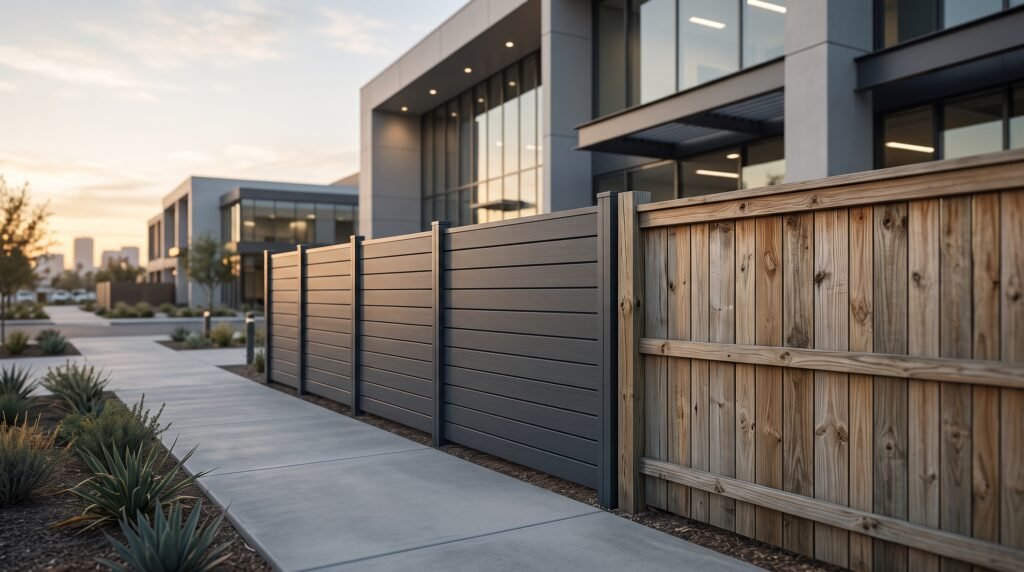
| Caption: Fig 5. Turnkey commercial installation of Structa Deck modular WPC   |
|          fencing system for a modern multi-family housing development.        |
+-------------------------------------------------------------------------------+
- Replace Unit-Price Bid Submittals with 10-Year Lifecycle Underwriting:
Equip commercial estimating teams with 10-year TCO financial schedules. Highlighting the 38.4% cumulative cash savings and NOI equity enhancement enables contractors to secure negotiated master subcontracts rather than competing in low-margin softwood bidding wars. - Implement an “80/20” Factory-Direct Sourcing Model:
Procure 80% of projected annual baseline project volume via direct Full Container Loads (FCL) from Structa Deck at source factory pricing. Maintain the remaining 20% in regional distribution hubs for just-in-time (JIT) infill and fast-track accessory fulfillment. - Standardize Exclusively on 360° Shielded Systems with Aluminum Posts:
Eliminate structural warranty liabilities by avoiding 1st-generation uncapped composite or hollow composite post profiles. Specify ASTM D7032-compliant co-extrusion composites matched with 6063-T6 structural aluminum posts rated for 110+ mph winds.
8. Conclusion & Next Steps for Procurement Teams
The commercial fencing sector has reached an economic inflection point. Escalating trade labor inflation, stringent ESG mandates, and the mathematical reality of lifecycle maintenance have rendered pressure-treated timber an unsustainable choice for modern commercial envelopes.
By specifying Structa Deck 2nd-Generation Co-Extruded WPC Systems, commercial contractors and distributors deliver superior aesthetics, eliminate recurring OpEx, and unlock substantial capital appreciation for project stakeholders—all supported by the cost certainty of direct-from-factory manufacturing.
Ready to Upgrade Your Commercial Project Specifications?
Partner directly with Structa Deck to scale your margins and streamline your architectural supply chain.
- 📦 Request a Free Architectural Sample Kit — Evaluate our 360° shield durability, 3D grain textures, and aluminum post profiles firsthand.
- 📑 Download the 2026 Structa Deck Commercial Catalog & CAD Submittals — Access complete technical specifications, ASTM test reports, and wind load engineering packages.
- 💬 Get a Factory-Direct Wholesale Project Quote — Connect with our senior commercial supply chain specialists for container-direct FOB/DDP volume pricing.
┌──────────────────────────────────────────────────────────────────────────────┐
│  STRUCTA DECK GLOBAL COMMERCIAL PROCUREMENT DIVISION                         │
│  Direct Factory Supply Chain | Custom OEM/ODM | Certified ASTM & EN Testing  │
│  🌐 Website: https://structadeck.com/                                        │
│  📧 Commercial Inquiries: commercial@structadeck.com                         │
└──────────────────────────────────────────────────────────────────────────────┘